
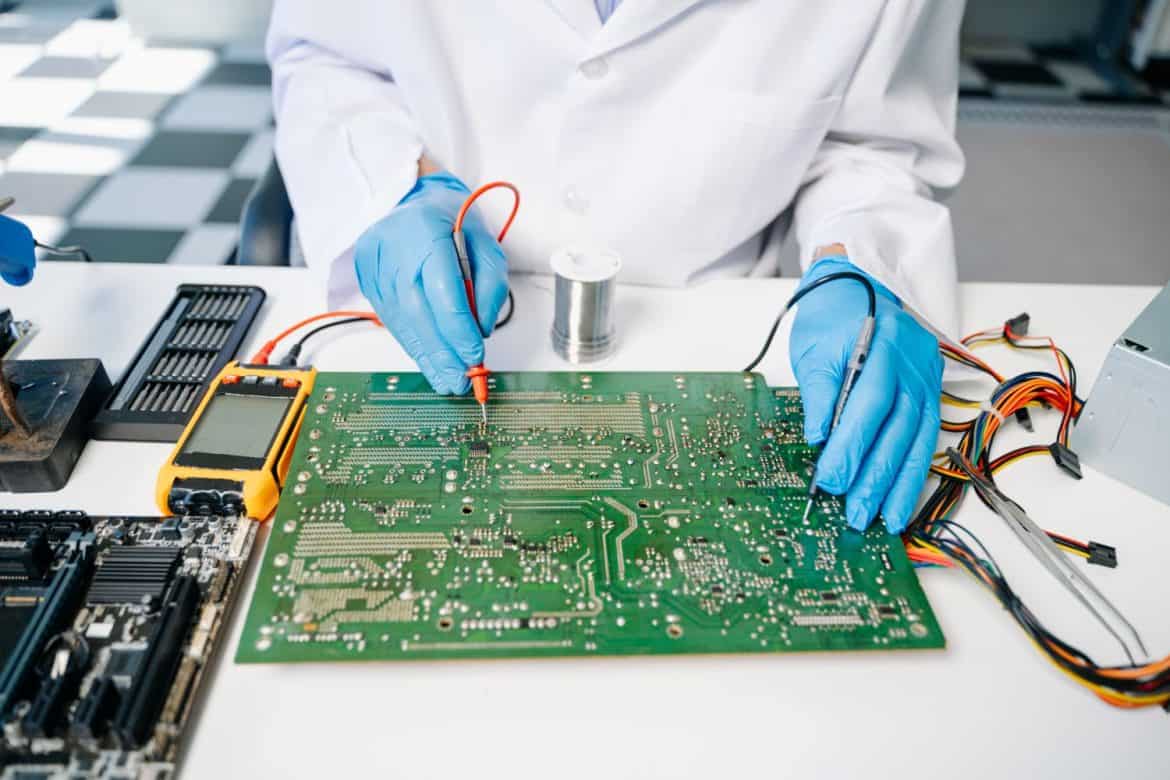
Anion Testing in PCB Manufacturing: Where Contamination Enters and How to Catch It
Printed circuit board manufacturing involves a sequence of chemical processes—etching, plating, soldering, cleaning—each representing a potential entry point for ionic contamination that an anion test is specifically designed to detect. For PCB manufacturers, understanding exactly where contamination risk arises within the production process is essential for building effective quality control rather than treating anion testing as an isolated final inspection step.
Tracing Contamination Through the PCB Manufacturing Process
Ionic contamination doesn’t originate from a single source—it can be introduced at multiple stages throughout PCB fabrication and assembly, each requiring different monitoring and control approaches.
- Etching processes use chemical solutions to remove unwanted copper, and residual etching chemistry that isn’t fully rinsed away can leave chloride, sulfate, or other ionic residue embedded in the board surface or trapped within microscopic surface features.
- Plating processes, whether for copper, gold, or other surface finishes, involve chemical baths that can leave process residue if rinsing steps are inadequate, particularly in boards with complex geometries like blind vias or high-density interconnects where thorough rinsing becomes more challenging.
- Soldering operations, especially wave soldering and reflow processes, introduce flux residue that, while designed to be largely benign, can leave measurable ionic contamination if cleaning processes afterward don’t fully remove it—a particularly common contamination source in no-clean flux processes where some residue is intentionally left behind and must be carefully controlled within acceptable limits.
- Handling and storage between manufacturing steps can introduce contamination from human contact, packaging materials, or environmental exposure, particularly in facilities without adequate contamination control protocols for work-in-progress boards.
Why Process-Stage Testing Matters More Than Final Inspection Alone
Implementing testing at intermediate process stages provides critical diagnostic data that final inspection alone cannot offer. The table below compares the operational differences and troubleshooting capabilities between final-stage inspection and process-stage testing:
| Testing Approach | Diagnostic Capability | Operational Impact & Troubleshooting Efficiency |
| Final Inspection Alone | Detects that a contamination issue exists on the finished PCB, but cannot determine origin. | Requires broad, time-consuming troubleshooting across the entire production line. |
| Process-Stage Testing | Pinpoints exact contamination levels at specific steps (after etching, plating, or post-solder cleaning). | Enables immediate, targeted corrective action at the root source, minimizing downtime. |
Setting Appropriate Cleanliness Thresholds for PCBs
PCB cleanliness requirements are often defined by industry standards, particularly those published by IPC, which establish ionic contamination thresholds based on the board’s intended application and reliability requirements. Boards destined for high-reliability applications—automotive, aerospace, medical, or industrial control systems—typically face stricter contamination limits than boards for less demanding consumer applications, reflecting the different consequences of a corrosion-related failure in each context.
Manufacturers producing boards for multiple market segments often need to apply different internal quality thresholds depending on the specific board’s end application, rather than using a single blanket specification across their entire product range.
The Role of Cleaning Process Validation
Given that cleaning processes—whether aqueous cleaning after soldering or specific rinse steps after etching and plating—are the primary defense against ionic contamination, validating that these cleaning processes actually achieve their intended contamination removal is a critical quality control activity. This typically involves periodic anion testing specifically designed to verify cleaning process effectiveness, distinct from testing intended to catch general contamination issues.
Cleaning process validation becomes particularly important when a manufacturer changes cleaning chemistry, equipment, or process parameters, since even well-intentioned process improvements can sometimes inadvertently reduce cleaning effectiveness if not properly validated before full production implementation.
Building Ionic Contamination Control Into New Product Introduction
For new PCB designs, particularly those with novel geometries, higher circuit density, or new surface finish requirements, establishing an ionic contamination baseline during new product introduction helps identify potential cleaning challenges before the design moves into high-volume production, where correcting a contamination issue becomes considerably more costly and disruptive.
Anion Testing Services in Malaysia
Malaysia’s substantial PCB manufacturing and electronics assembly sector requires accessible, reliable anion testing capability to support both routine production quality control and the more detailed process-stage investigation needed when contamination issues arise.
Alstesting Laboratory Testing service in Malaysia provides ion chromatography-based anion testing suited to PCB manufacturing quality programs, from process validation through final board inspection. Manufacturers seeking anion test support for PCB contamination control benefit from testing capability that helps pinpoint exactly where in the manufacturing process ionic contamination risk requires attention.
Frequently Asked Questions
Should every PCB production lot be tested, or only periodic samples?
This depends on the board’s application and risk classification—high-reliability boards for automotive or medical applications often warrant more frequent or even lot-by-lot testing, while lower-risk consumer applications may use statistically representative periodic sampling as part of routine quality monitoring.
How does no-clean flux affect anion testing interpretation?
No-clean flux is formulated to leave minimal, low-risk residue behind without requiring a post-solder cleaning step, meaning anion test results for no-clean processes are typically evaluated against different acceptance criteria than boards that undergo full post-solder cleaning, reflecting the intentionally different residue profile.
Can anion testing be performed on boards with conformal coating already applied?
Testing coated boards presents additional complexity, since the coating itself can interfere with contamination extraction; testing is generally more straightforward and more commonly performed before conformal coating is applied, allowing any contamination issues to be identified and corrected prior to the coating step.
What’s a reasonable response time when anion testing reveals a process-stage contamination issue?
Response urgency typically depends on production volume and the board’s reliability requirements, but many manufacturers aim to identify and implement corrective action within days of confirming a contamination trend, particularly for high-reliability product lines where extended exposure to a contamination issue could affect substantial production volume.

